
Our History
Founding, 1949–1950
ACEC Minnesota was formed in 1949 when a group of consulting engineers recognized the need to protect the professional practice of engineering in Minnesota. At the time, engineers faced increasing pressure from unlicensed practice, inconsistent fee structures, delayed payments, and the expansion of public and private entities offering engineering services in ways that undermined the independent consulting model.
These engineers concluded that the long-term strength of their profession required collective action. They organized as the Minnesota Association of Consulting Engineers and convened their first formal meeting in St. Paul in March that year. In 1950, the association adopted a constitution and bylaws, elected its first officers, and formally established its mission:
To promote better understanding among consulting engineers and related professions, and to advance the general welfare of both the public and the engineering profession.
From its inception, the association focused on professional standards, innovation, integrity, and public safety.
Legislative Engagement, 1960s
During the 1960s, the organization expanded its capacity and influence. Under Executive Director Earl Oxley, ACEC Minnesota strengthened its presence at the Minnesota Legislature and developed a more structured advocacy approach. The association evolved with dedicated executive leadership and legislative engagement.
This period marked the beginning of sustained public policy involvement. ACEC Minnesota tracked legislation, testified before committees, formed coalitions, and worked directly with lawmakers on issues affecting consulting engineers and infrastructure delivery. The association also expanded staffing and formalized relationships with legislative counsel to ensure consistent representation at the Capitol.
Advocacy became a core function of the organization and remains central to its mission today.

1955 Annual Meeting
In 1967, ACEC Minnesota established the Engineering Excellence Awards (EEA) to recognize outstanding engineering achievement across the state. The program elevated the visibility of consulting engineers, strengthened relationships with public and private clients, and positioned engineering firms as leaders in infrastructure innovation.
State award recipients compete in the national Engineering Excellence Awards program through ACEC. The awards continue today as a public demonstration of engineering impact and remain one of the association’s signature initiatives.
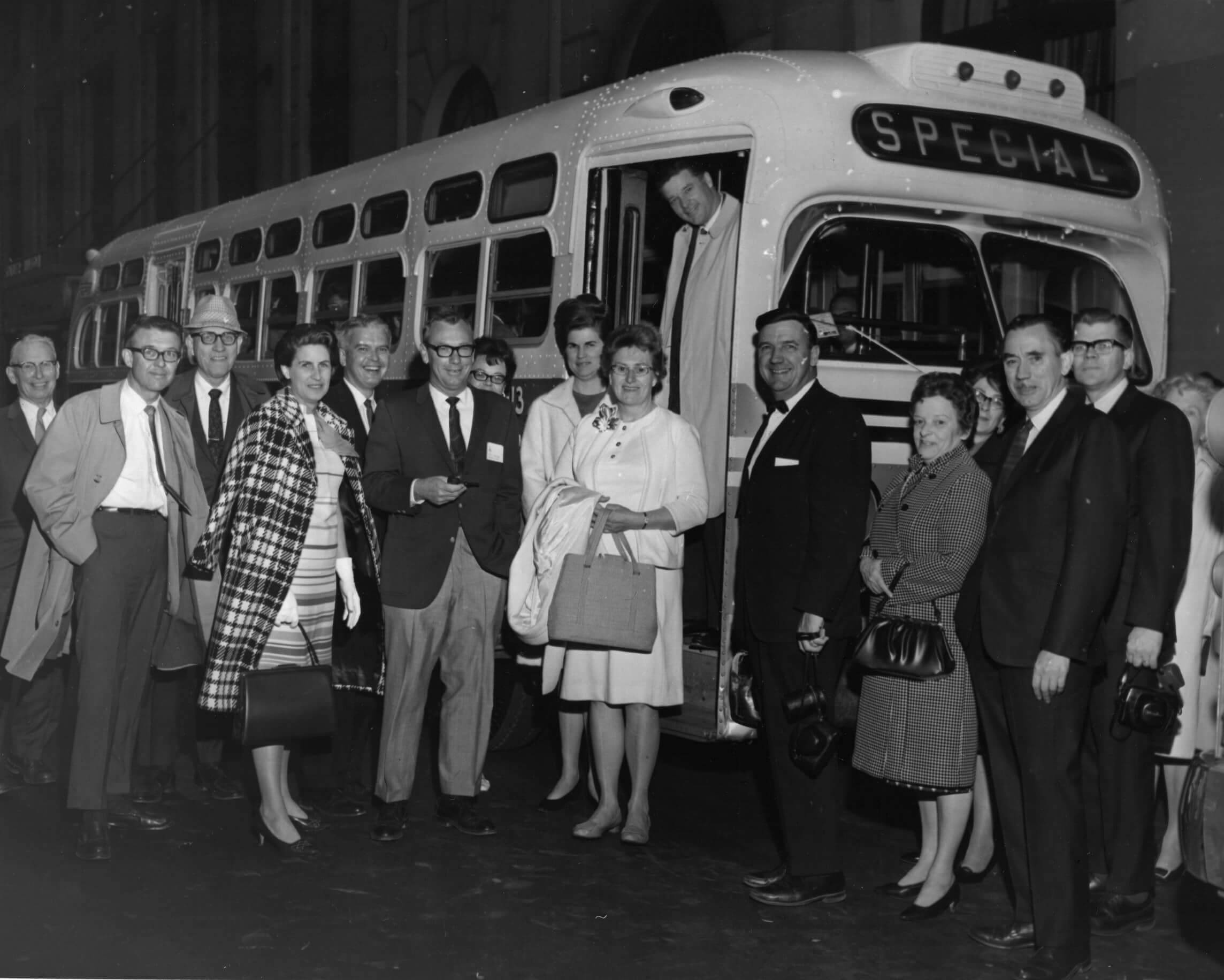
Minnesota's delegation at the ACEC national conference, circa 1960s.
Industry Evolution and Adaptation, 1970s and Beyond
The 1970s brought significant regulatory and economic changes. Environmental regulations and new technical standards reshaped project delivery and design expectations.
Consulting engineering firms adapted by expanding expertise in environmental compliance, energy efficiency, pollution mitigation, and advanced building systems. These changes increased the complexity of engineering work while creating new opportunities for innovation.
As infrastructure systems grew more sophisticated, the role of the consulting engineer expanded accordingly. Firms deepened specialization across civil, structural, mechanical, electrical, transportation, water resources, environmental, and related disciplines. Multidisciplinary collaboration became standard practice.
Modern Era
Today, ACEC Minnesota represents more than 100 consulting engineering firms employing over 7,500 professionals. Member firms design and support infrastructure that underpins Minnesota’s economy and quality of life, including transportation systems, water and wastewater facilities, energy infrastructure, public buildings, environmental restoration projects, and private development.
ACEC Minnesota is one of 51 state and regional councils affiliated with the American Council of Engineering Companies in Washington, DC. Through this federation, member firms participate in coordinated national advocacy while maintaining strong state-level representation.
The organization continues to focus on advancing the business of engineering through advocacy, leadership development, business resources, and operational excellence. While the regulatory environment, project delivery models, and technology have evolved since 1949, the core purpose remains consistent:
Protect the professional practice of consulting engineering and strengthen the firms that deliver Minnesota’s infrastructure.